Why Insights Still Don’t Lead to Action
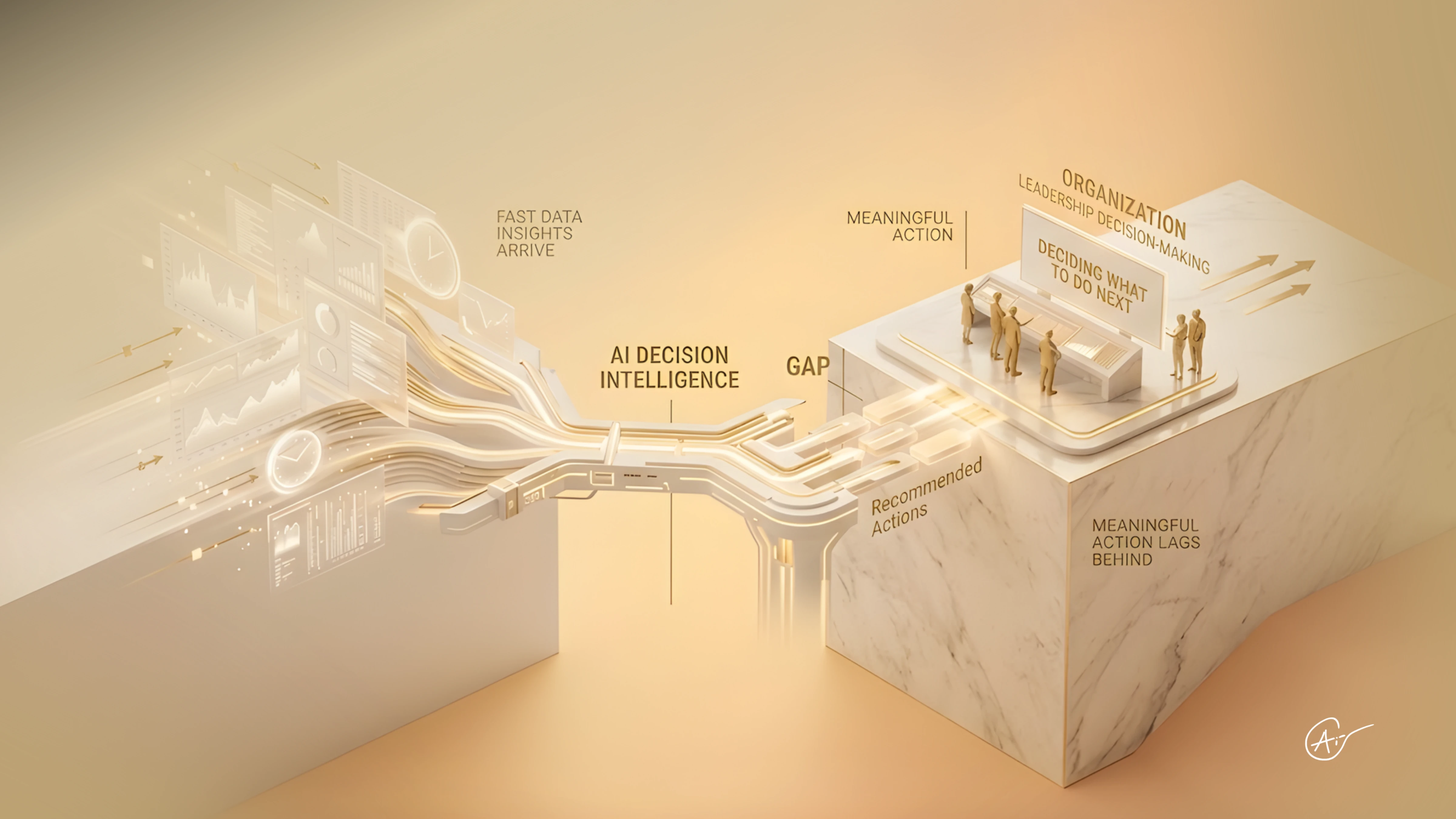
AI Decision Intelligence has become essential as more organizations confront a familiar frustration: insights arrive faster than ever, but meaningful action still lags behind. By mid‑2026, most leaders aren’t struggling with a lack of data. They’re struggling with deciding what to do next.
AI in business now powers meeting summaries, performance analytics, market monitoring, and real‑time alerts. Dashboards are full. Reports are polished. Yet decisions often stall. Reviews extend. Approvals pile up. The gap between seeing a signal and responding to it keeps widening.
This delay is what we call Insight Latency. It’s the moment when something important is detected, but systems and teams aren’t structured to move from information to decision quickly or confidently.
AI Decision Intelligence exists to close that gap. Not by generating more insights, but by designing decision‑ready systems where data consistently leads somewhere.
For a foundational explanation of how decision intelligence frameworks turn raw data into smarter outcomes, see Decision Intelligence 101: Turning Data Into Smarter Business Outcomes.
How Intuitive Operations Approaches AI Decision Intelligence
At Intuitive Operations, AI isn’t treated as a feature or a tool layered onto existing workflows. It’s treated as operational infrastructure.
The goal is to reduce the distance between signal and response.
AI Decision Intelligence builds on traditional decision intelligence frameworks, but goes further by ensuring decisions happen at the pace of modern business. Instead of asking leaders to interpret endless dashboards, systems are designed to surface context, options, and next steps in ways people can trust.
Three structural shifts consistently matter.
1. Moving Beyond the Static Dashboard
Traditional business intelligence tools explain what happened yesterday. They do very little to help teams decide what to do next.
A dashboard might show declining sales or rising costs, but it rarely explains what actions are available or which tradeoffs deserve attention. As Digital Bricks (2025) notes, this limitation has accelerated the adoption of agent‑based systems that move beyond reporting and into decision preparation.
If information doesn’t suggest a clear next move, it isn’t decision‑ready.
In practice, this means using task‑specific agents that triage situations, model scenarios, and prepare recovery or growth options for human approval. Appinventiv (2026) documents this shift in healthcare administration, where AI‑assisted pre‑decision workflows reduced staff workload by up to 40 percent by handling analysis before human review.
2. Governance, Trust, and Explainable Decisions
Speed alone does not create better outcomes.
When AI decision systems recommend major operational changes without explanation, hesitation increases. Leaders slow down because they cannot confidently stand behind logic they cannot see.
This trust gap is well documented. Trindel (2026) argues that explainability and governance must be embedded by design, otherwise AI systems become liabilities instead of accelerators.
Structured metadata plays a critical role here. Clean, modular, machine‑readable information allows AI to reason within an organization’s actual constraints and priorities. Without that structure, AI Decision Intelligence becomes fragile. With it, decision‑making becomes faster because the reasoning is visible and accountable.
3. Designing for Human Agency
In 2026, one of the fastest‑growing concerns around AI in business is the loss of perceived agency. Leaders increasingly receive recommendations they did not request, do not fully understand, or do not feel responsible for.
That is a design problem, not a leadership failure.
At Intuitive Operations, our protocol treats AI‑driven decision making as a way to automate the what and the how, so humans can focus on the why. Talentnet Group (2025) describes this shift as moving AI from cost‑cutting automation into a strategic decision catalyst.
When systems handle analysis and scenario modeling, leaders regain space for judgment, ethics, and long‑term vision. These remain areas where human intelligence is essential.
Putting It Into Practice: A 2026 Checklist
Reducing Insight Latency requires structural focus, not wholesale reinvention.
Audit your data velocity
Ask how long it takes for a real‑world change to appear as a suggested action. Sira Consulting (2026) notes that delays at this stage are one of the most common blockers between insight and business impact.
Deploy task‑specific agents
The most effective operational decision intelligence setups rely on specialized agents rather than single, overloaded systems. MoogleLabs (2026) refers to this swarm approach as the emerging standard for practical AI leadership.
Prioritize information gain
If AI only repeats what teams already know, it adds little value. Google’s recent updates prioritize information that introduces new, meaningful signals rather than recycled summaries (Keyword.com, 2026).
The Bottom Line
The next phase of business will not be defined by who invests the most in AI or collects the most data. It will be defined by who designs the clearest rules for action.
AI Decision Intelligence is not about insight generation. It is about building decision‑making systems where information reliably translates into outcomes. When data moves cleanly from signal to decision, organizations gain speed without losing control.
Reference
- Appinventiv. (2026). How AI in healthcare administration cut staff workload by 40%. https://appinventiv.com/blog/ai-in-healthcare-administration/
- Digital Bricks. (2025). 7 AI trends to watch in 2026. https://www.digitalbricks.ai/blog-posts/7-ai-trends-to-watch-in-2026
- Keyword.com. (2026). How to rank for AI overviews in 2026. https://keyword.com/blog/how-to-rank-for-ai-overviews/
- MoogleLabs. (2026). AI trends 2026: A practical guide leaders should actually read. https://medium.com/@mooglelabs/ai-trends-2026-a-practical-guide-leaders-should-actually-read-7bbb8a28f21b
- Sira Consulting. (2026). From data to decisions: How AI turns insights into business impact. https://siraconsultinginc.com/from-data-to-decisions-how-ai-turns-insights-into-business-impact/
- Trindel, K. (2026). Trust by design: How Workday builds AI that puts people first. Workday Blog. https://blog.workday.com/en-us/how-workday-builds-ai-puts-people-first.html
- Valiance Solutions. (2026). From insight to impact: How AI turns decisions into action. https://valiancesolutions.com/2026/02/06/from-insight-to-impact-how-ai-turns-decisions-into-action/
Leave a Reply