New Standard for AI
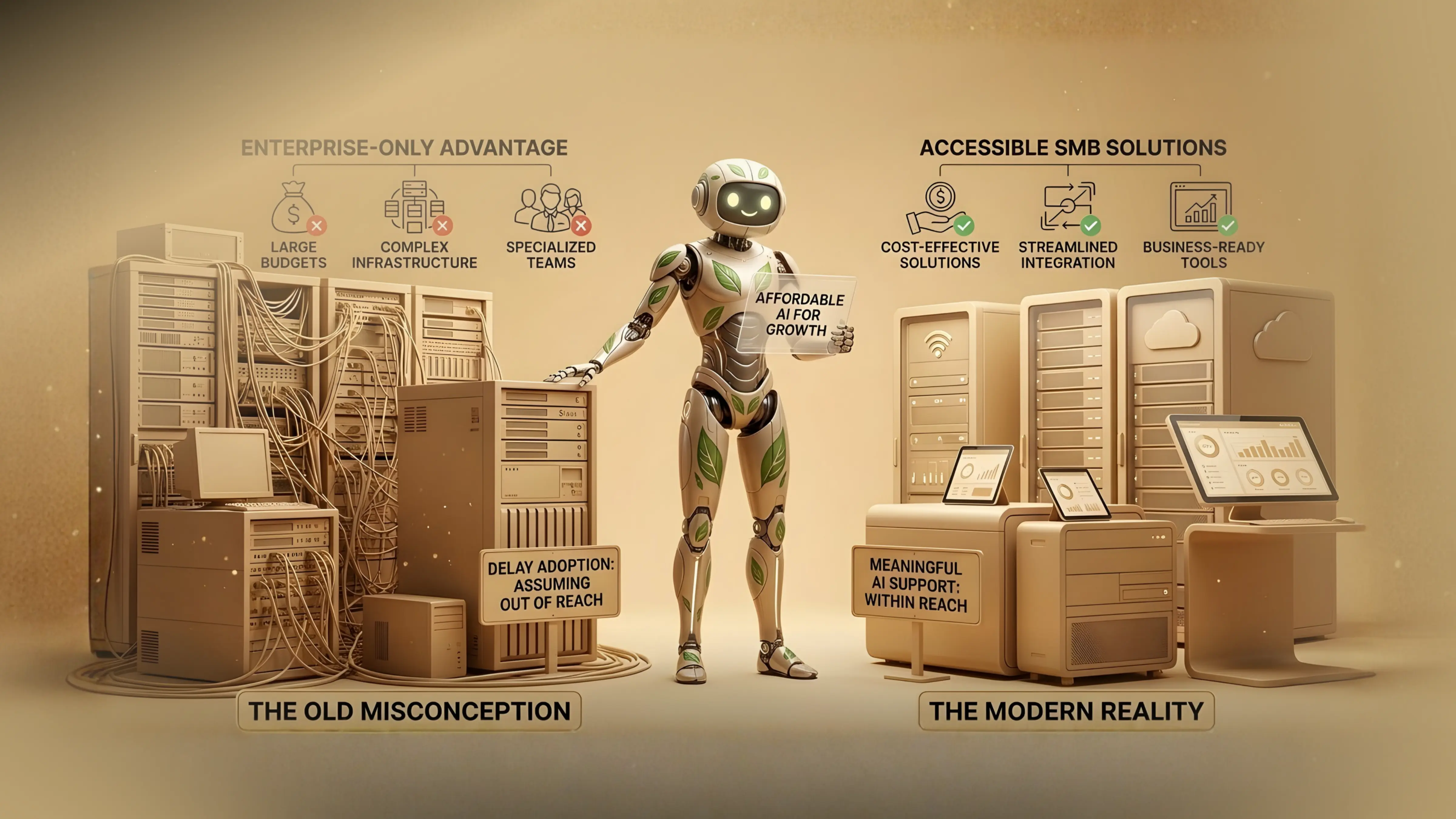
Affordable AI solutions for SMBs are often misunderstood. Artificial intelligence is frequently framed as an enterprise-only advantage that requires large budgets, complex infrastructure, and specialized teams. This perception causes many small businesses to delay adoption, assuming meaningful AI support is out of reach.
The reality is far more encouraging.
Today, the most impactful AI for SMBs is affordable, easy to implement, and often already embedded within the platforms businesses use every day. From an Intuitive Operations perspective, the goal of adoption is not to chase the newest trend. It is to choose tools that reduce friction and allow teams to focus on meaningful work. When AI supports operational flow, even small teams can operate with enterprise-level efficiency without the enterprise price tag.
What “Affordable AI” Really Means
Cost alone does not define affordability in AI. The term refers to solutions that deliver practical business value while keeping complexity, overhead, and onboarding friction low.
Across successful SMB implementations, affordable AI solutions tend to share three core characteristics:
- Problem Focused: Each tool addresses a specific, high‑friction task instead of trying to do everything at once.
- Low Friction: Setup is minimal, employee retraining is limited, and adoption feels natural within existing workflows.
- Scalable: As the business grows, these tools integrate smoothly and adapt without requiring a system overhaul.
Industry perspectives from McKinsey, Gartner, and Forbes consistently reinforce this definition. Across their analysis, return on investment, ease of adoption, and operational impact matter far more than feature breadth for small and midsize businesses.
The most effective AI tools for SMBs rarely seek attention. Quietly, they save time, reduce errors, and improve consistency. As a result, teams gain more space for human judgment, creativity, and strategic thinking.
The Foundational Step: Auditing Your Friction
Before selecting any AI tool, one foundational step determines whether the investment will succeed or fail. Skipping this step often leads to wasted spend on tools that are never fully used.
Objective:
Identify tasks that consume time without requiring deep expertise.
The Action:
Search for repetition inside daily operations. Consider these prompts during an internal audit:
- Which tasks consistently feel tedious at the start of every week?
- Where do errors most often appear due to manual input?
- What work prevents focus on customers, strategy, or growth?
Typical friction points include repetitive support questions, manual reporting, meeting documentation, and content formatting. Affordable AI produces the strongest results when it removes these everyday barriers rather than adding new systems to manage.
Four High‑Impact Categories for SMBs
1. Customer Support and Communication
One of the most accessible entry points into AI is customer communication. AI‑assisted inboxes and chat tools help route inquiries, draft consistent replies, and maintain brand voice even during peak periods. Faster responses improve customer experience without increasing team workload.
2. Content and Marketing Momentum
For many SMBs, content creation consumes more time than expected. Writing assistants accelerate the move from a blank page to a usable draft. When positioned as support tools rather than replacements, these systems allow teams to maintain human‑led strategy while increasing consistency and output.
3. Administrative Reflex Tools
Meeting summaries, note‑taking, and task organization no longer need to rely on manual effort. Low‑cost AI tools now handle many administrative functions automatically, reducing cognitive load and preventing burnout across small teams.
4. Data‑Driven Insights for Non‑Analysts
Modern AI increasingly sits on top of spreadsheets and CRMs, translating raw data into clear, actionable insights. Instead of overwhelming dashboards, these systems surface risk signals, trends, and opportunities in plain language before problems escalate.
Where Most SMBs Should Start
Broad automation strategies rarely deliver early wins. For most organizations, progress begins with one recurring pain point that appears every week.
When customer inquiries consume hours, support automation offers immediate relief. If reporting takes longer than decision‑making, summarization and insight tools quickly return time. For teams buried in meeting notes, administrative AI creates fast and visible value.
Early success matters. Solving one clear problem builds confidence, internal trust, and momentum far more effectively than a wide rollout. In affordable AI adoption, progress beats perfection.
Example Tool Categories
The purpose of AI adoption is not tool accumulation. Value comes from friction removal. Many SMBs begin with solutions already embedded in familiar platforms or broadly adopted for narrow use cases:
- Customer Support
AI-assisted inboxes or chat tools integrated with existing helpdesk platforms - Meetings and Administration
Automated note-taking and summarization tools such as Otter or native calendar AI features - Content Support
AI writing assistants embedded in document editors or CMS platforms - Insights and Reporting
AI layers that summarize CRM or spreadsheet data in plain language
Tool choice matters far less than task selection. A simple solution used consistently will outperform a powerful tool that adds complexity.
A Practical, Budget‑Friendly Adoption Path
To avoid unnecessary spend, follow a simplified Intuitive Roadmap:
- Begin with the problem, not the platform. Avoid purchasing AI without a defined use case.
- Review current tools first. Many CRMs, email systems, and project platforms already include unused AI features.
- Test against real work. Use free trials on active tasks, not idealized demos.
- Measure time returned. If a tool does not reclaim at least two hours per week, reconsider the subscription.
Affordable AI earns its place by simplifying work, not by showcasing advanced features.
Conclusion: Intelligence Over Expense
Affordable AI for SMBs is not about pursuing innovation for its own sake. The true value lies in making everyday operations smoother, faster, and more consistent.
Viewed through the lens of Intuitive Operations, AI becomes a practical advantage instead of an expensive experiment. Starting small and focusing on genuine friction builds systems that are efficient, adaptable, and centered on human capability.
That is where affordable AI delivers its real impact without breaking the bank.
Final Takeaway
The Golden Rule of Affordable AI:
Do not pay for features. Pay for friction removal.
The most valuable AI tool in any SMB stack is the one that eliminates manual effort and allows teams to operate at their highest level of focus and creativity.
Strategic Insight
Successful AI adoption depends as much on mindset as on price. Before committing to tools based on popularity or perceived savings, it is essential to understand how low‑friction systems generate meaningful impact.
For a deeper look at the principles behind choosing affordable AI that truly delivers value, read High Impact, Low Friction: The Truth About Affordable AI for Business on the Rules of Intelligence blog.
References
- Gartner. (2024). Market trend: SMBs overcome operational hurdles with AI software.
- https://www.gartner.com/en/documents/5398063
- Levy, I. (2024). Making AI truly valuable to SMBs: Current gaps and opportunities. Forbes Technology Council.
- https://www.forbes.com/councils/forbestechcouncil/2024/05/21/making-ai-truly-valuable-to-smbs-current-gaps-and-opportunities/
- McKinsey & Company. (2023). Winning the SMB tech market in a challenging economy.
- https://www.mckinsey.com/industries/technology-media-and-telecommunications/our-insights/winning-the-smb-tech-market-in-a-challenging-economy
Leave a Reply