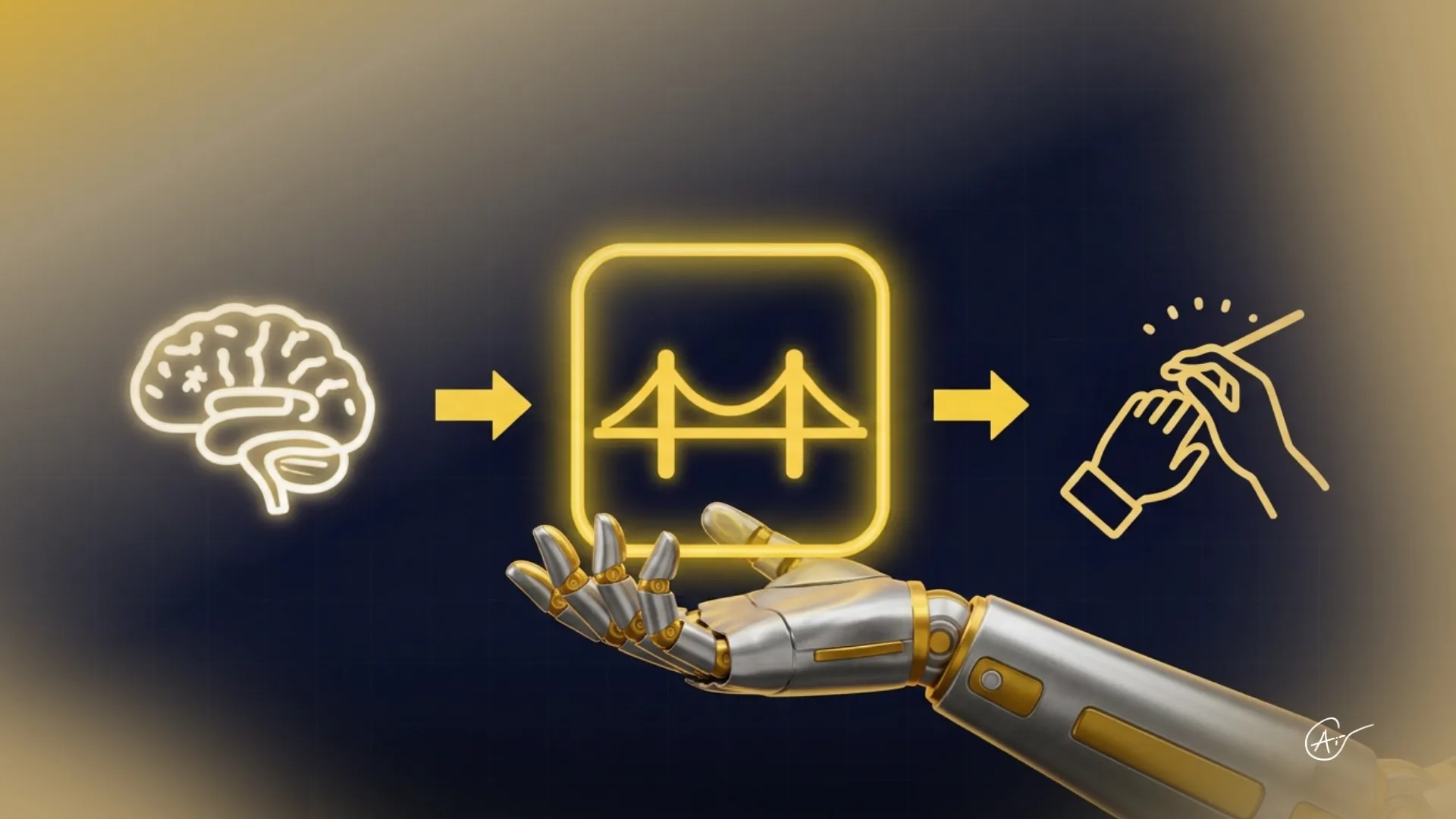
Prompting and process are often treated as the beginning and end of AI adoption. Teams prompt AI tools to generate drafts, summaries, or insights, then expect improved business outcomes to follow. However, most AI initiatives stall in between. According to Apotheker et al. (2025), organizations frequently struggle to translate AI activity into measurable operational impact. The issue is not model quality or prompt engineering. The issue is a missing operational bridge.
This missing layer is the hidden step between prompting and process. It is where intent, ownership, workflow design, and human handoffs are defined. When this step is skipped, AI generates output but work does not move faster or better.
What the Hidden Step Between Prompting and Process Really Is
The hidden step between prompting and process is not more prompting. It is not full automation either. Instead, it is the operational design that determines what happens after AI produces an output.
This step answers practical questions:
- Who reviews or acts on the AI output?
- What happens when AI is uncertain or wrong?
- How does the output enter an existing workflow?
- How is success measured end to end?
According to McKinsey & Company (2025), most AI value is lost after insights are generated, not before. Without this middle layer, AI outputs pile up while teams continue working manually.
Why Prompting Alone Breaks at Scale
Prompting works well for individual productivity. A person asks a question and receives an answer. However, at the team level, prompting alone does not scale.
For example:
- Marketing teams generate AI drafts, but publishing still bottlenecks.
- Support teams get AI suggestions, but no one owns the follow‑up.
- Finance teams receive AI analysis, but decisions remain unchanged.
According to Deloitte (2025), AI initiatives fail when outputs are not embedded into workflows with clear ownership. Prompting creates content. Process creates outcomes. The hidden step connects the two.
The Hidden Step Between Prompting and Process in Practice
Smart teams treat the hidden step as a design phase. They intentionally map how AI output flows into human work.
Examples across functions include:
Customer support
AI drafts responses. Agents review and send. Exceptions route to a senior queue.
Marketing
AI generates content drafts. Editors approve. Approved content auto‑schedules.
Finance
AI flags anomalies. Analysts investigate. Findings trigger defined actions.
Leadership
AI summarizes reports. Leaders validate insights. Decisions follow a cadence.
According to Harvard Business Review (2025), trust in AI increases when review points and accountability are explicit. The goal is collaboration, not replacement.
Framework Box: Where Your Prompting and Process Setup Is Breaking
Use this framework to identify gaps in the hidden step between prompting and process:
If this is happening…
- AI outputs are created but not used
- Teams redo work manually after AI
- No one owns AI follow‑ups
- Exceptions pile up
- Metrics focus on usage instead of outcomes
Then the hidden step is missing…
- Clear handoff rules
- Defined ownership
- Exception workflows
- Embedded integration
- End‑to‑end measurement
According to Pedowitz Group (2025), teams adopt tools that reduce effort and feel safe to use. The hidden step creates both.
How to Build the Bridge Between Prompting and Process
To fix broken AI setups, teams must design the bridge explicitly:
- Map the full workflow. Identify where AI enters and where humans act.
- Define handoffs. Specify who reviews, approves, or escalates AI output.
- Plan for exceptions. Decide how uncertain or edge cases are handled.
- Embed into tools. Keep AI inside systems people already use.
- Measure outcomes. Track cycle time, quality, and decision impact.
According to Microsoft (2024), AI adoption succeeds when workflows change, not just tools.
Final Takeaway
The hidden step between prompting and process is where most AI setups break. Prompting alone is not adoption. Process alone is not intelligence. The bridge between them is operational design.
When teams define ownership, handoffs, and measurement, AI becomes part of how work gets done. That is when AI moves from activity to capability.
References
- Apotheker, J., Duranton, S., Lukic, V., de Bellefonds, N., Iyer, S., Bouffault, O., & de Laubier, R. (2025). From potential to profit: Closing the AI impact gap. Retrieved from https://www.bcg.com/publications/2025/closing-the-ai-impact-gap
- Deloitte. (2025). Why AI adoption fails without operational change. Retrieved from https://www.deloitte.com/insights/us/en/focus/cognitive-technologies/ai-adoption.html
- Harvard Business Review. (2025). Workers don’t trust AI. Here’s how companies can change that. Retrieved from https://hbr.org/2025/11/workers-dont-trust-ai-heres-how-companies-can-change-that
- McKinsey & Company. (2025). The state of AI in 2025. Retrieved from https://www.mckinsey.com/capabilities/quantumblack/our-insights/the-state-of-ai
- Microsoft. (2024). Work trend index: AI adoption and employee experience. Retrieved from https://www.microsoft.com/worklab/work-trend-index
- Pedowitz Group. (2025). Why teams resist new digital processes. Retrieved from https://www.pedowitzgroup.com/why-wont-teams-adopt-new-digital-processes
Leave a Reply