Introduction
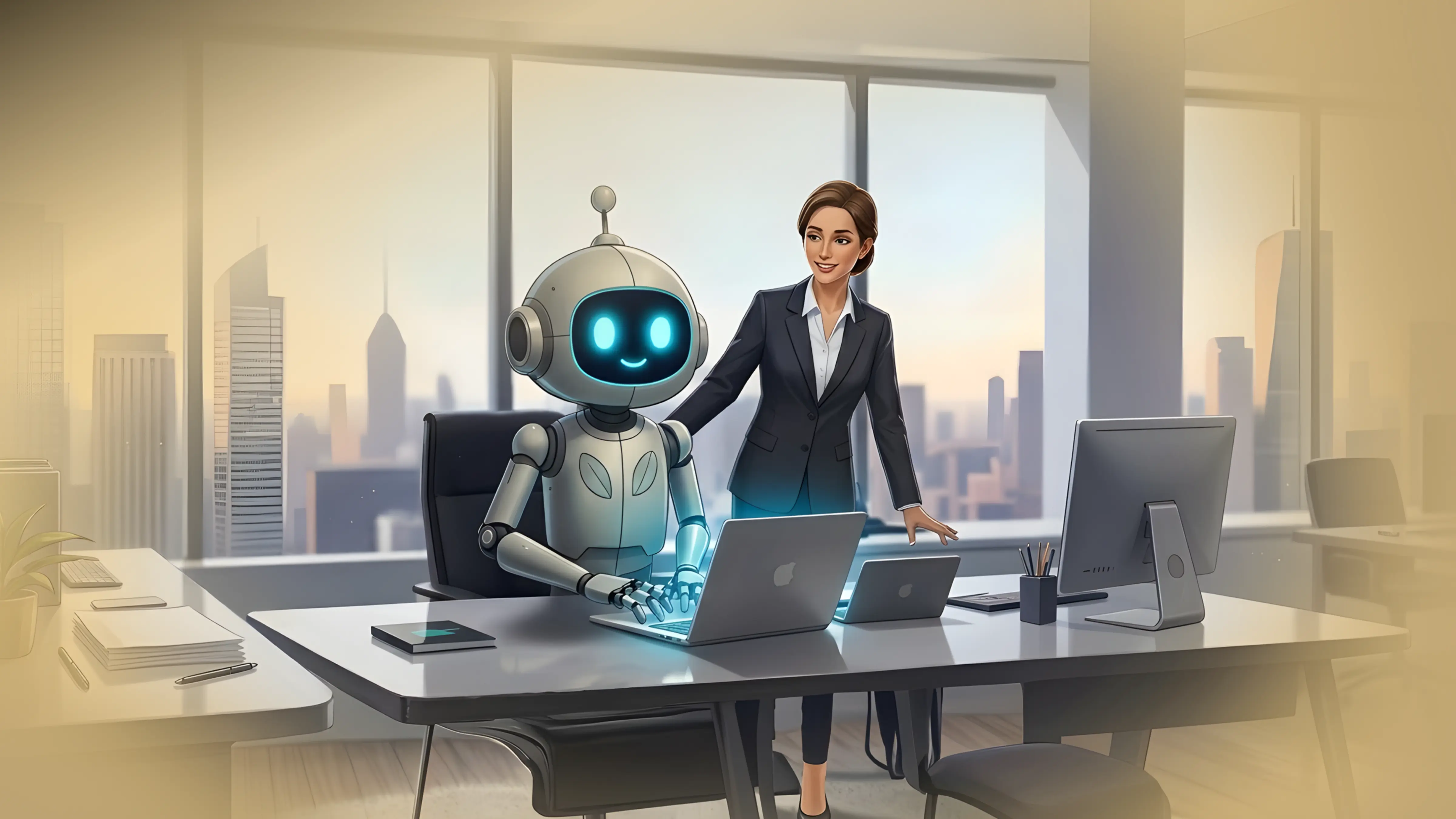
Human-AI collaboration in SMBs is becoming one of the most important determinants of business performance in 2026. As artificial intelligence becomes embedded in everyday workflows, organizations are discovering that technology alone does not create value. Value emerges when AI augments human judgment, creativity, and experience rather than attempting to replace them (Davenport & Kirby, 2016).
While headlines often focus on automation and job displacement, research shows that businesses adopting a human-first AI strategy achieve stronger outcomes. Teams that understand how to work with AI systems demonstrate higher productivity, improved decision quality, and greater employee engagement (Wilson & Daugherty, 2018). For SMBs in particular, optimizing team performance through human-AI collaboration can be a critical competitive advantage.
This article explores practical strategies for enabling effective human-AI collaboration, managing organizational change, and measuring productivity gains in SMB environments.
Why Human-AI Collaboration Matters More Than Ever
AI excels at processing large volumes of data, identifying patterns, and generating recommendations at speed. Humans excel at contextual understanding, ethical judgment, emotional intelligence, and creative problem-solving. When these strengths are combined, teams can operate more effectively than either humans or AI alone.
According to Harvard Business Review, organizations that redesign work around collaboration between humans and AI achieve better outcomes than those that focus solely on automation (Wilson & Daugherty, 2018). For SMBs, this means shifting from an efficiency-only mindset to one focused on capability amplification.
Core Principles of Human-First AI in SMBs
1. Design AI to Support, Not Replace, Roles
Successful SMBs deploy AI as a decision-support system rather than a decision-maker. AI can surface insights, highlight risks, and automate repetitive tasks, while humans retain accountability and final judgment.
Examples include AI-assisted customer support, forecasting tools for inventory planning, and analytics platforms that support leadership decisions.
2. Redesign Workflows, Not Just Tools
Introducing AI without rethinking workflows often leads to frustration and underutilization. Human-AI collaboration requires redefining responsibilities, decision points, and handoffs between people and systems.
Organizations that explicitly document how AI fits into daily work see higher adoption and lower resistance (Shrestha et al., 2019).
Change Management for Human-AI Collaboration
Resistance to AI adoption is rarely about technology. It is usually about uncertainty, fear of obsolescence, or lack of clarity around expectations.
Effective change management strategies include:
- Clear communication about AI’s role and limitations
- Transparency around how AI outputs are generated and used
- Training focused on interpretation, not just tool usage
- Involving employees early in AI design and testing
Research suggests that when employees are involved in AI implementation decisions, trust and adoption increase significantly (Raisch & Krakowski, 2021).
Measuring Team Performance Gains from AI
To understand whether human-AI collaboration is working, SMBs need to move beyond vanity metrics. Useful indicators include:
- Reduction in time spent on repetitive tasks
- Improvement in decision accuracy or consistency
- Increased output per employee without increased workload
- Employee satisfaction and confidence in AI-assisted decisions
A McKinsey study found that organizations measuring both operational and human-centered metrics were more likely to sustain AI-driven performance improvements over time (McKinsey & Company, 2025).
Common Pitfalls and How to Avoid Them
| Pitfall | How to Avoid It |
|---|---|
| Treating AI as a replacement for staff | Position AI as a support system with clear human accountability |
| Lack of role clarity | Define decision ownership between humans and AI |
| Insufficient training | Focus on interpretation, judgment, and critical thinking |
| Ignoring employee sentiment | Actively gather feedback and adjust implementation |
Tools That Support Human-AI Collaboration
Choosing the right tools helps reinforce collaboration rather than automation-first thinking. Examples include:
- AI copilots embedded in productivity tools
- Business intelligence platforms with explainable AI features
- Workflow automation tools with human approval checkpoints
- Knowledge management systems enhanced by AI search and summarization
The most effective tools are those that integrate naturally into existing workflows and make human expertise more impactful rather than redundant.
Industry Insight
Industry research consistently shows that AI does not eliminate leadership roles but fundamentally reshapes them. As Wilson and Daugherty (2018) explain, AI shifts managers away from task execution and toward higher-value responsibilities such as judgment, ethical oversight, coaching, and strategic decision-making. Rather than replacing human expertise, AI amplifies it by providing faster insights, pattern recognition, and scenario analysis, while accountability and context remain firmly human-led. For SMBs, this reinforces the importance of viewing AI as a managerial support system that enhances leadership effectiveness rather than a substitute for it.
Frequently Asked Questions
Does AI reduce the need for employees in SMBs?
In most cases, AI changes job roles rather than eliminating them. Employees shift from execution to oversight, analysis, and decision-making.
How can SMBs ensure employees trust AI systems?
Trust is built through transparency, explainability, training, and consistent validation of AI outputs.
What is the biggest mistake SMBs make with AI adoption?
Focusing on tools instead of people and processes is the most common cause of failure.
Conclusion
Human-AI collaboration in SMBs is not about choosing between people and technology. It is about designing systems where each complements the other. Organizations that adopt a human-first AI strategy in 2026 will be better positioned to improve team performance, adapt to change, and create sustainable competitive advantage.
References
- Davenport, T. H., & Kirby, J. (2016). Only humans need apply: Winners and losers in the age of smart machines. HarperBusiness.
- McKinsey & Company. (2025). The state of AI in 2025: From experimentation to ROI. McKinsey Global Institute.
- Raisch, S., & Krakowski, S. (2021). Artificial intelligence and management: The automation–augmentation paradox. Academy of Management Review, 46(1), 192–210. https://doi.org/10.5465/amr.2018.0072
- Shrestha, Y. R., Ben-Menahem, S. M., & von Krogh, G. (2019). Organizational decision-making structures in the age of artificial intelligence. California Management Review, 61(4), 66–83. https://doi.org/10.1177/0008125619862257
- Wilson, H. J., & Daugherty, P. R. (2018). Collaborative intelligence: Humans and AI are joining forces. Harvard Business Review, 96(4), 114–123.
Leave a Reply