Don’t Build Your AI Castle on Sand
It’s 2026, and AI is everywhere—writing your emails, chatting with your customers, and maybe even suggesting what you should have for lunch. For small and medium-sized businesses (SMBs), the temptation to dive headfirst into the latest AI trends—like generative content tools, workflow agents, and predictive analytics—is stronger than ever. After all, who doesn’t want to automate the boring stuff and watch revenue graphs soar?
But here’s the catch, if you don’t have your AI governance house in order, you’re not building a rocket ship—you’re building a rocket without a navigation system. And that’s a one-way ticket to Scope Creep City, with stops at Risk Junction and Compliance Catastrophe.
Why Governance First? Because “Move Fast and Break Things” is So 2010
Let’s face it, most AI governance advice out there is written for mega-corporations with armies of lawyers and ethicists. But SMBs need governance too—just the right-sized, practical kind. Think of it as installing guardrails before you let your new AI Ferrari out of the garage.
AI governance isn’t about red tape or endless meetings. It’s about:
- Setting clear policies and responsibilities,
- Ensuring your data is clean and protected,
- Training your team on what’s cool (and what’s not) with AI,
- And making sure you’re not accidentally breaking any laws (hello, GDPR and the EU AI Act).
In short, governance is your AI insurance policy. It keeps you compliant, ethical, and ready to scale—without the drama.
The Most Searched AI Topics for SMBs—And Why Governance Matters
Here’s what SMBs are searching for right now:
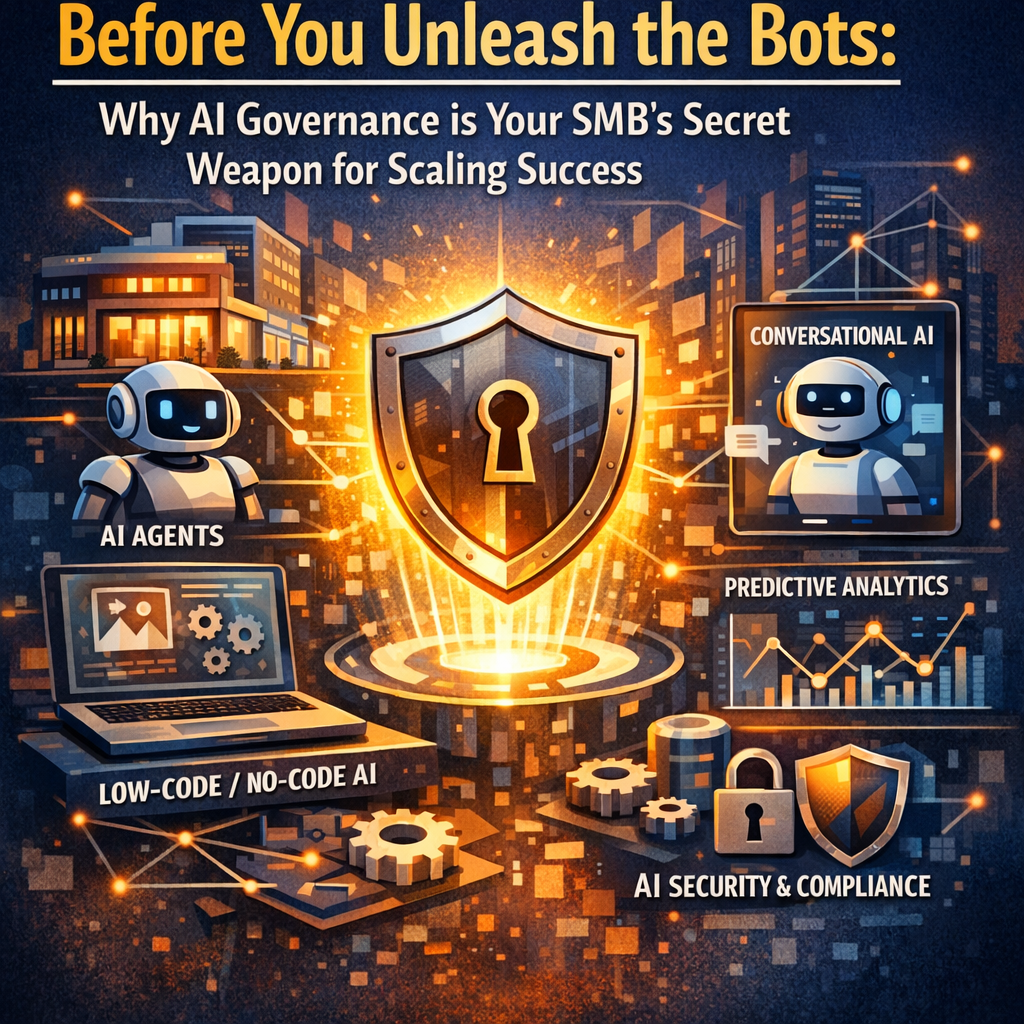
- AI agents & workflow automation
- Generative AI for content & marketing
- Conversational AI for customer service
- Predictive analytics
- Low-code/no-code AI platforms
- AI security & compliance
These tools promise efficiency, growth, and a competitive edge. But without governance, they can also introduce bias, privacy risks, and regulatory headaches faster than you can say “machine learning model”.
Building Your AI Governance Foundation (Without Drowning in Bureaucracy)
1. Know Thy AI (and Where It’s Hiding)
Start by mapping out where AI is already in use—officially or unofficially. You’d be surprised how many “shadow AIs” are lurking in spreadsheets and SaaS tools.
2. Set the Rules of the Game
Draft simple, clear AI policies. Who’s responsible for what? What data can be used? What’s off-limits? No need for a 100-page manual—just enough to set expectations and boundaries.
3. Train Your Team (AI Literacy 101)
Make sure everyone—from the intern to the CEO—knows the basics of AI, your policies, and why governance matters. A little training now saves a lot of headaches later.
4. Monitor and Enforce
Check that your policies are being followed. If someone colors outside the lines, address it early. This isn’t about punishment—it’s about keeping your AI journey on track.
5. Stay Compliant (and Document Everything)
Keep up with relevant laws (like GDPR, the EU AI Act, or local privacy rules). Document your decisions, data sources, and risk assessments. If regulators come knocking, you’ll be ready.
6. Keep It Practical and Scalable
Don’t overcomplicate things. Your governance should fit your business size and culture. As your AI use grows, your governance can grow with it—no need to start with a NASA-level framework.
Global Best Practices—Right-Sized for SMBs
- Use a mix of approaches: Combine rules-based, risk-based, and principles-based governance. Flexibility is key.
- Leverage existing frameworks: OECD AI Principles, NIST AI Risk Management Framework, and local guidance (like New Zealand’s focus on Māori Data Sovereignty) can be adapted to your needs.
- Embed ethics by design: Don’t bolt on ethics at the end—bake it in from the start.
- Future-proof your policies: Keep an eye on regulatory changes, especially if you export or operate internationally.
Trust, Efficiency, and Growth (With Fewer Surprises)
IBM found that 80% of business leaders see explainability, ethics, bias, or trust as major roadblocks to AI adoption. Good governance tackles these issues head-on, building trust with customers, partners, and regulators.
And here’s the kicker: investing in AI governance isn’t just about avoiding fines. It actually makes your AI projects more efficient and scalable—so you can ride the AI wave instead of wiping out.
Governance—Your AI Growth Superpower
Before you chase the latest AI trend, make sure your governance foundation is solid. It’s the difference between scaling with confidence and scrambling to fix problems after they explode.
So, whether you’re a scrappy startup or a growing SMB, remember — a little governance goes a long way. Set your policies, train your team, and keep your AI ambitions in check. Then—and only then—let the bots out to play.
Because in the art of scoping, a well-governed project is a masterpiece in the making.
References:
Right-sizing AI governance: Starting the conversation for SMBs | IAPP
(2) AI Governance for NZ SMBs. Building Futures, Not Bureaucracies | LinkedIn
Leave a Reply