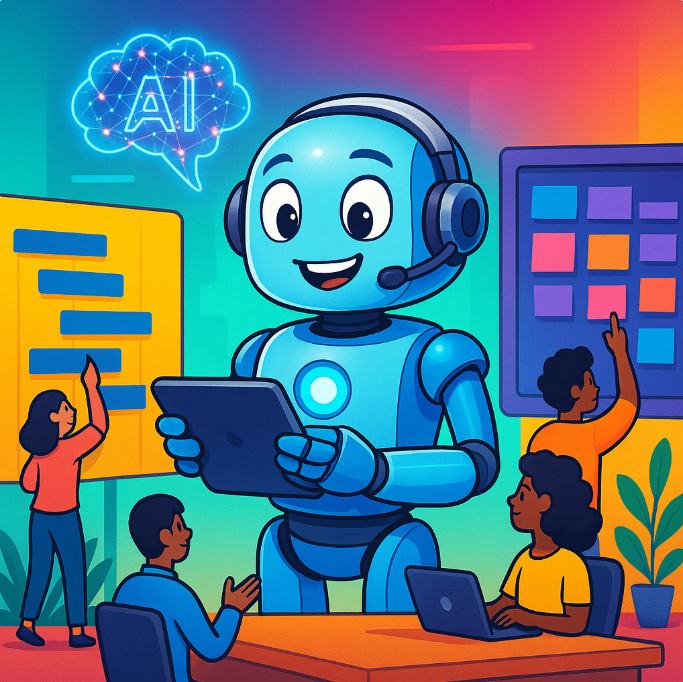
If you’ve ever worked on a project—whether it’s building a house, launching a new website, or organizing a community event—you know that good project management is the secret sauce that keeps everything running smoothly. But what happens when the project is about building Artificial Intelligence (AI)? Suddenly, the rules change. Let’s break down how managing AI projects is different from traditional projects, using simple language, real-world examples, and a few helpful analogies.
Project Management: The Basics
Let’s start with a quick analogy. Imagine you’re a movie director. Your job is to bring together actors, crew, and resources to create a film. You need a script (the plan), a cast (the team), and a schedule (the timeline). This is how traditional project management works: you plan, you organize, and you execute.
Now, imagine you’re directing a movie, but the script keeps changing, the actors improvise new lines every day, and the audience’s preferences shift halfway through filming. That’s what managing an AI project can feel like!
Traditional Projects vs. AI Projects: What’s the Difference?
Let’s break down the key differences in a way that’s easy to understand.
1. Planning and Scoping: Fixed vs. Flexible
- Traditional Projects: Think of building a house. You have blueprints, a list of materials, and a clear idea of what the finished house will look like. The plan is detailed and doesn’t change much.
- AI Projects: Imagine sculpting a statue from a block of marble, but you’re not sure what the final shape should be. You chip away, step back, and adjust as you go. In AI, the plan is flexible because you often discover new things as you work with the data.
2. Development and Testing: Predictable vs. Iterative
- Traditional Projects: Like following a recipe. You know the steps, and if you follow them, you get the same cake every time.
- AI Projects: It’s more like experimenting in the kitchen. You try different ingredients, taste as you go, and sometimes the cake turns out differently each time. AI models need to be trained, tested, and tweaked repeatedly because results can change with new data.
3. The Role of Data: Supporting Cast vs. Main Star
- Traditional Projects: Data is important, but it’s not usually the main focus.
- AI Projects: Data is the star of the show. The quality and quantity of your data can make or break the project. Imagine trying to make a movie with blurry footage—no matter how good your actors are, the final product will suffer.
4. Team Composition: Standard Roles vs. New Specialists
- Traditional Projects: You have project managers, developers, designers, and testers.
- AI Projects: You need data scientists (the “chefs” who experiment with recipes), machine learning engineers, data engineers, and even AI ethicists to make sure the AI behaves responsibly. It’s a more diverse and specialized team.
5. Communication: Predictable Updates vs. Ongoing Conversations
- Traditional Projects: Regular status meetings and clear milestones keep everyone on track.
- AI Projects: Because things can change quickly, there’s a need for more frequent, transparent communication. Stakeholders (the people invested in the project) need to understand that results may be uncertain and evolve over time.
6. Risk Management: Known Risks vs. New Challenges
- Traditional Projects: Risks are usually well-understood—like running out of paint or missing a deadline.
- AI Projects: New risks pop up, like biased data, ethical concerns, or unexpected behavior from the AI. Managing these risks requires constant vigilance and sometimes new tools.
7. Ethics and Compliance: Simple Rules vs. Complex Questions
- Traditional Projects: Follow industry standards and privacy laws.
- AI Projects: You must also consider fairness, transparency, and whether the AI could unintentionally harm people. Regulations are evolving, and ethical questions are front and center.
8. Resource Management: Predictable Needs vs. High-Tech Demands
- Traditional Projects: You know how many bricks or hours you’ll need.
- AI Projects: You might need powerful computers (think: supercharged laptops or cloud servers) to train your AI models, and these resources can be expensive and in high demand.
9. Deployment and Monitoring: One-and-Done vs. Continuous Care
- Traditional Projects: Once the project is delivered, you move into maintenance mode.
- AI Projects: The work doesn’t stop at launch. AI models need to be monitored and updated regularly to make sure they keep working as intended, especially as new data comes in.
Real-World Examples: Successes and Failures
Let’s look at some real stories to see these differences in action:
- Success: Google’s AlphaFold used AI to solve a decades-old biology problem, but only after years of experimentation and learning from failures.
- Success: Netflix’s recommendation engine keeps viewers engaged by constantly learning from what people watch.
- Failure: IBM Watson for Oncology struggled because it couldn’t adapt to the messy, real-world data in hospitals.
- Failure: Air Canada’s AI chatbot gave out wrong information, leading to legal trouble—showing how important it is to test and monitor AI systems carefully.
What made the successes work? High-quality data, clear goals, teamwork between humans and AI, and a willingness to keep improving. Failures often came from poor data, unclear objectives, or not enough testing and oversight.
Tips for Non-Technical Audiences
- Ask for Real-World Examples: If you’re not sure what an AI project is doing, ask for examples or analogies.
- Look for Visuals: Diagrams and charts can make complex ideas easier to grasp.
- Focus on Impact: Instead of getting lost in technical details, ask how the AI will affect your work or daily life.
- Don’t Be Afraid to Ask Questions: AI is new for everyone, and good project managers should be able to explain things in plain language.
Managing AI projects is a bit like learning to ride a bike on a winding, ever-changing road. It requires flexibility, new skills, and a willingness to adapt. By understanding the key differences—and using simple analogies and real-world examples—you can better appreciate the unique challenges and opportunities that come with bringing AI to life.
Whether you’re a project manager, a team member, or just curious about how AI projects work, remember: the journey may be unpredictable, but with the right approach, it can lead to amazing results.
References
- 60 Detailed Artificial Intelligence Case Studies [2025] – DigitalDefynd
- Is There a Metaphor for Project Management? – Forward Momentum: Delivering Results
- Using Analogies and Storytelling in Project and Program Management
- AI Project Management vs. Any Software Project Management
- Visual project management
- Using Your Soft Skills to Teach AI Concepts | Dice.com Career Advice
 AI Catalyst
Leave a comment