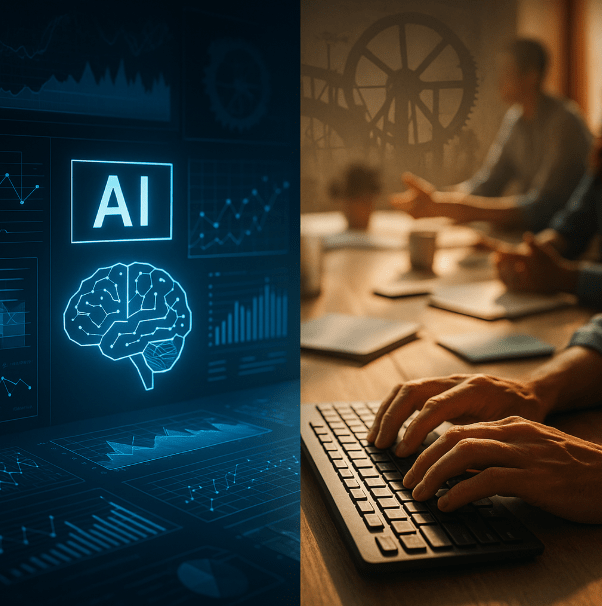
The rapid rise of artificial intelligence is reshaping the world of work, productivity, and society at large. In a recent conversation hosted by Section, Greg Shove (CEO of Section), Brian Merchant (author of Blood in the Machine), and moderator Maxwell delved into the historical, economic, and ethical dimensions of AI’s impact—drawing parallels to the Industrial Revolution and the Luddites, and exploring the uncertainties that lie ahead.
1. From Luddites to Large Language Models: Historical Parallels
Brian Merchant opened the discussion by reframing the Luddites—not as anti-technology zealots, but as skilled workers whose livelihoods were upended by automation. Their fight was for fairness, protections, and a voice in how technology was deployed. Today, similar anxieties echo among artists, writers, and coders facing disruption from generative AI. The core issue is not technology itself, but who controls its rollout and who benefits from its gains.
2. Job Loss, Transformation, and Creation
A central theme was the fear—and reality—of job displacement. Will AI lead to mass unemployment, or simply reorganize the labor market? Greg and Brian debated whether new jobs and industries will emerge quickly enough to offset losses in fields like journalism, art, and entry-level knowledge work. Brian was skeptical about the sustainability of new roles like “prompt engineer,” while Greg pointed to historical precedents where unforeseen industries (think Airbnb or AWS) eventually created new opportunities. The timeline, however, remains uncertain.
3. AI in the Workforce: Tool or Threat?
Greg and Brian agreed: AI is a powerful productivity booster, but it comes with risks. Greg emphasized the need for AI proficiency in the knowledge economy—workers must integrate AI into their workflows to stay competitive. Brian warned of over-reliance, such as students outsourcing critical thinking to AI, and the danger of companies using AI as a pretext for unnecessary job cuts. Ultimately, they agreed that individuals and organizations must be intentional about how they adopt or resist AI, guided by their own values and goals.
4. Economic and Social Implications
AI’s deflationary effect on wages and job markets was a recurring concern. While AI can reduce costs, it may also lower wages and replace certain types of work, especially in knowledge-based fields. The conversation touched on Universal Basic Income (UBI) as a possible safety net, though opinions differed on its feasibility. Both Greg and Brian were wary of the growing concentration of power among tech giants like OpenAI and Google, warning that this could limit opportunities for smaller players and concentrate wealth even further.
5. The Challenge of Regulation
Brian called for policy interventions to ensure AI’s benefits are widely shared, noting that most productivity gains currently flow to a small elite. The regulatory landscape is fragmented: while some states are taking action, federal efforts lag behind. Greg observed that large enterprises are slower to adopt AI, which could buy time to develop better frameworks—but the window may be closing fast.
6. AI in Education: Double-Edged Sword
AI’s impact on education is complex. While some studies suggest AI can enhance critical thinking, others warn it encourages cognitive laziness by making it easy to bypass intellectual effort. The long-term consequences for students—and for society—remain unclear.
7. AI and Economic Uncertainty: The Role of Recessions and Tariffs
Although tariffs were only briefly mentioned, the discussion highlighted how economic uncertainty—including that generated by tariffs—can accelerate AI adoption. Recessions, in particular, serve as catalysts: companies seek cost-cutting measures, management uses downturns to justify automation, and businesses turn to AI rather than hiring new employees. This “air cover” can lead to faster, sometimes more aggressive, implementation of AI, with significant implications for job displacement and economic inequality.
Key Challenges and Unresolved Questions
- Timing Mismatch: There’s a real risk that job displacement will outpace the creation of new roles, leading to a painful transition period.
- Policy Gaps: Effective regulation is needed, but political will and clarity are lacking.
- Corporate Behavior: Economic uncertainty may be used to justify workforce reductions and accelerate automation.
- Workforce Adaptation: Reskilling and upskilling are essential, but not everyone will adapt at the same pace.
- Ethical and Legal Issues: The legal landscape around AI-generated content and intellectual property is still evolving, leaving creators in limbo.
- Work-Life Balance: As AI boosts productivity, how should society distribute the gains—shorter workweeks, higher wages, or something else?
- Concentration of Power: The dominance of a few tech giants raises concerns about competition and equitable access to AI’s benefits.
Conclusion: Navigating an Uncertain Future
The conversation underscored both the promise and peril of AI. While it has the potential to revolutionize industries and improve productivity, it also risks deepening inequality, displacing jobs, and concentrating power. The path forward requires thoughtful, intentional adoption of AI, robust policy frameworks, and a commitment to ensuring that technology serves humanity—not the other way around.
As Greg and Brian concluded, the future is not predetermined. Individuals, businesses, and policymakers all have a role to play in shaping how AI is integrated into our lives. The challenge—and opportunity—is to ensure that the benefits of AI are shared widely, and that society remains in control of its technological destiny.
Resources:
 AI Catalyst
Leave a comment