In recent years, Artificial Intelligence (AI) has become a buzzword, with ChatGPT taking center stage in many discussions. However, the realm of AI extends far beyond conversational models. This blog post aims to demystify the various types of AI and their applications, providing an accessible overview for those who may not be fully versed in the latest AI developments.
Understanding the AI Landscape
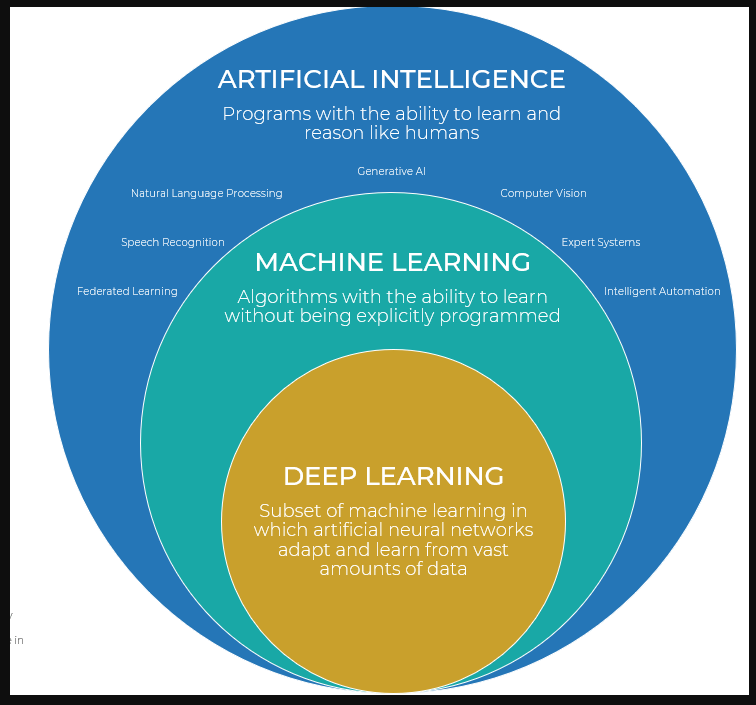
Artificial Intelligence is a broad field that encompasses various technologies designed to simulate human intelligence in machines. While ChatGPT has captured public imagination with its ability to engage in human-like conversations, it represents just one facet of AI’s capabilities.
Let’s explore the main types of AI and how they’re shaping our world.
Machine Learning: The Foundation of Modern AI
At the heart of many AI systems lies Machine Learning (ML), a subset of AI that enables computers to learn from data and improve their performance over time without explicit programming. Think of ML as teaching a child to recognize animals by showing them pictures and telling them the names. Over time, the child learns to identify animals on their own, similar to how a machine learning model learns from data.
Machine Learning can be further divided into three main categories:
- Supervised Learning: This is like having a teacher guide you through a textbook, providing answers along the way. The AI is trained on labeled data, learning to make predictions or decisions based on this guidance.
- Unsupervised Learning: Imagine being given a box of mixed Lego pieces without instructions. The AI must find patterns and relationships within the data on its own, clustering similar items together.
- Reinforcement Learning: This is similar to training a pet. The AI learns through trial and error, receiving rewards for correct actions and penalties for mistakes, gradually improving its performance.
Neural Networks and Deep Learning: Mimicking the Human Brain
Neural Networks are a fascinating branch of AI inspired by the structure of the human brain. They consist of interconnected nodes (like neurons) that work together to process information and make decisions. Deep Learning takes this concept further by using neural networks with many layers to analyze complex data.
To understand Deep Learning, imagine peeling an onion. Each layer of the neural network peels back more complexity and detail from the data, leading to a deeper understanding of the information at hand.
Natural Language Processing: Bridging the Human-Computer Language Gap
Natural Language Processing (NLP) is the field of AI that focuses on enabling machines to understand and respond to human language. It’s like having a universal translator that helps computers comprehend and generate human speech and text. NLP powers applications like:
- Voice assistants (Siri, Alexa)
- Language translation services
- Sentiment analysis tools for social media monitoring
Computer Vision: Giving Machines the Power of Sight
Computer Vision enables machines to interpret and understand visual information from the world around them. It’s as if we’ve given computers a pair of eyes and the ability to recognize what they see.
This technology is used in:
- Facial recognition systems
- Autonomous vehicles
- Medical image analysis for disease detection
AI in Action: Real-World Applications
AI is not just a concept confined to research labs; it’s actively transforming various industries:
Healthcare
AI is revolutionizing healthcare by improving diagnostics and enabling personalized medicine. Machine learning algorithms can analyze medical images to detect diseases like pneumonia and tuberculosis with impressive accuracy. AI-powered systems also deliver healthcare services remotely, allowing for real-time monitoring and adjustments to treatment plans.
Finance
In the financial sector, AI is employed for fraud detection, algorithmic trading, and risk assessment. AI systems continuously adapt to recognize fraudulent patterns more effectively, protecting consumers and businesses alike.
Retail and E-commerce
AI enhances the shopping experience through personalized recommendations and dynamic pricing. By analyzing customer behavior and purchase history, AI offers tailored product suggestions, making online shopping more intuitive and enjoyable.
Manufacturing
In factories, AI-powered robots increase productivity and precision in manufacturing processes. AI also predicts equipment maintenance needs, minimizing downtime and optimizing production schedules.
Transportation
AI is driving the development of self-driving cars and intelligent traffic management systems. These applications aim to improve safety, reduce congestion, and save time and fuel.
The Future of AI: Beyond ChatGPT
As we look to the future, AI continues to evolve at a rapid pace. Recent developments include:
- Quantum AI: Integrating quantum computing with AI to solve complex problems faster than ever before.
- AI for Climate Change: Using AI models to predict weather patterns with greater accuracy and develop strategies for reducing carbon emissions.
- Creative AI: Pushing the boundaries of creativity with AI systems that can compose music, generate visual art, and even write novels.
While ChatGPT has brought conversational AI into the spotlight, it’s crucial to recognize the vast and diverse landscape of Artificial Intelligence. From machine learning algorithms that power recommendation systems to computer vision technologies enabling autonomous vehicles, AI is reshaping our world in countless ways. As AI continues to advance, it promises to bring even more innovative solutions to global challenges. By understanding the different types of AI and their applications, we can better appreciate the technology’s potential and prepare for a future where AI plays an increasingly significant role in our daily lives.
References
- “Machine Learning: An Introduction.” Stanford Encyclopedia of Philosophy.
- “Deep Learning.” MIT Technology Review.
- “Natural Language Processing: What It Is and Why It Matters.” SAS Insights.
- “Computer Vision: What It Is and Why It Matters.” IBM Cloud Learn Hub.
- “Understanding Deep Learning.” Nature.
- “Reinforcement Learning: An Introduction.” MIT Press.
- “AI in Healthcare: A Comprehensive Overview.” Journal of Medical Systems.
- “The Role of Artificial Intelligence in Finance.” Financial Management Association.
- “AI in Retail: Transforming the Shopping Experience.” Harvard Business Review.
- “Artificial Intelligence in Manufacturing: Present and Future.” Manufacturing Letters.
- “The Impact of AI on Transportation Systems.” IEEE Intelligent Transportation Systems Magazine.
 AI Catalyst
Leave a comment